Porter Founder Story of Pranav Goel Uttam Digga and Vikas Choudhary

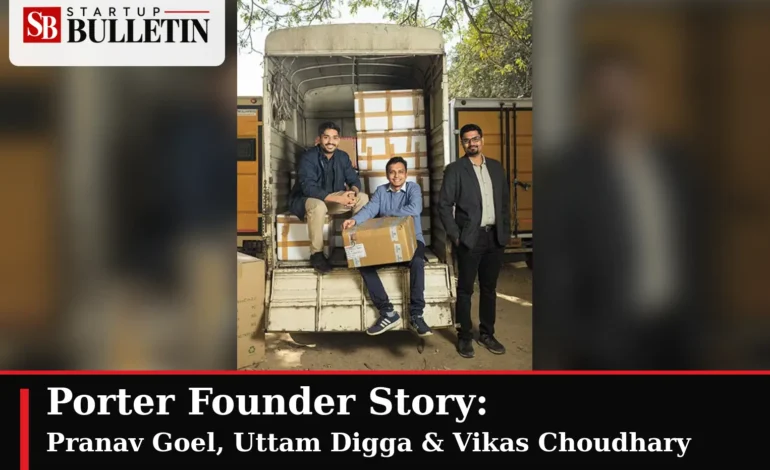
Porter was founded in 2014 by Pranav Goel, Uttam Digga and Vikas Choudhary. Early reporting dates the launch to August 2014 and describes the founders as IIT graduates. Pranav and Uttam knew each other from IIT Kharagpur, while Pranav knew Vikas from Kota. They focused on a problem many small businesses faced every day: finding a suitable vehicle for moving goods within a city at a predictable price and time.
The company built a technology marketplace connecting customers with driver-partners operating mini trucks, tempos and later two-wheelers and other vehicle types. Porter expanded into packers and movers, enterprise logistics and intercity services. Its value came from organising a fragmented market rather than owning every vehicle itself.
In May 2025, Porter closed a Series F round led by Kedaara Capital and Wellington Management, with continued participation from Vitruvian Partners. Media reports placed the round at $200 million and valued Porter at roughly $1.1 billion to $1.2 billion. Regulatory-filing coverage in August 2026 reported FY2026 operating revenue of ₹6,649 crore and net profit of ₹229 crore. The valuation is a reported estimate, while the financial figures were reported from company filings.
| Key point | Research based detail |
|---|---|
| Founders | Pranav Goel, Uttam Digga and Vikas Choudhary |
| Founded | August 2014 |
| Original market | Intracity goods transport |
| Early base | Mumbai; the company is now commonly described as Bengaluru based |
| Operating company | SmartShift Logistics Solutions Private Limited |
| Business model | Technology-led matching of customers and driver-partners, plus enterprise and relocation services |
| Early Series A | ₹35 crore reported in June 2015 from Sequoia Capital, Kae Capital and others |
| Series F | Closed in May 2025, led by Kedaara Capital and Wellington Management |
| Reported 2025 valuation | $1.1 billion to $1.2 billion according to media sources |
| FY2026 reported results | ₹6,649 crore operating revenue and ₹229 crore net profit from regulatory-filing coverage |
| Current CEO | Uttam Digga was identified as co-founder and CEO in the 2025 funding announcement |
The three Porter founders
| Founder | Early contribution | Leadership context |
|---|---|---|
| Pranav Goel | Business concept, marketplace development, fundraising and early CEO leadership | Later public references describe a wider strategic leadership role |
| Uttam Digga | Operations, scaling and business leadership | Identified as co-founder and CEO in the May 2025 Series F announcement |
| Vikas Choudhary | Technology and founding-team development | Receives co-founder credit even though later media often focuses on Pranav and Uttam |
Key timeline
| Year or date | What happened | Why it matters |
|---|---|---|
| Aug 2014 | Pranav Goel, Uttam Digga and Vikas Choudhary founded Porter. | The company targeted fragmented intracity goods transport. |
| Jun 2015 | Porter raised a reported ₹35 crore Series A. | Early capital supported product, driver network and city operations. |
| 2020 | Pandemic restrictions disrupted movement and changed delivery demand. | Porter had to protect supply while serving essential and business needs. |
| 2021 | A Series E round backed expansion and product development. | The company deepened its national logistics platform. |
| May 2025 | Porter closed Series F led by Kedaara and Wellington. | Media reports said the round moved Porter into the unicorn category. |
| FY2025 | Porter reported its first annual profit in regulatory-filing coverage. | The company moved from growth with losses to positive net income. |
| FY2026 | Operating revenue reached a reported ₹6,649 crore and net profit ₹229 crore. | The filings showed continued scale and higher profit. |
The problem in city goods transport
Before Porter, many small businesses found local commercial vehicles through phone calls, neighbourhood brokers or personal driver contacts. Prices could change by route, waiting time and bargaining power. Vehicle availability was uncertain, and customers had limited visibility after a driver left for delivery. Drivers, meanwhile, spent time waiting without a predictable flow of jobs.
The Porter founders saw a marketplace opportunity similar to ride hailing but with different operating needs. A goods vehicle carries boxes, furniture, retail stock or industrial materials rather than passengers. Customers need the correct vehicle size, help with loading in some cases and pricing that reflects distance and time. The app had to organise these details without pretending goods transport was identical to a taxi trip.
How the founders knew one another
Porter’s own founder interview says Pranav Goel met Uttam Digga at IIT Kharagpur and had known Vikas Choudhary since Kota. These prior relationships gave the team a base of trust before it entered a difficult operational sector. Pranav and Uttam had also worked in finance, while Vikas brought technical capability to the founding group.
A founder team with business and engineering skills could study the market from both sides. They needed to understand driver economics in the field and turn those observations into booking, pricing, matching and tracking software. The three-founder structure matters because later funding photographs often show only Pranav and Uttam, which can lead shorter articles to omit Vikas.
The first Porter service
Porter launched in Mumbai in August 2014 as an online logistics marketplace. Early users could request a vehicle for local goods movement instead of calling multiple operators. The platform matched the job with a driver-partner and aimed to provide clearer prices and availability. This reduced search effort for customers and could increase vehicle utilisation for drivers.
The marketplace model was asset-light compared with owning a full fleet, but it was not operationally light. Porter had to recruit drivers, verify documents, classify vehicle types, manage cancellations, resolve damage complaints and support cash or digital payments. Service quality depended on people and vehicles the company did not directly own.
Early funding and expansion
Business Standard reported that Porter raised ₹35 crore in a Series A round in June 2015 from Sequoia Capital, Kae Capital and other investors. The company was less than a year old. Early funding allowed it to invest in technology and build supply in more neighbourhoods, but opening a city required local operations rather than only a national app launch.
Network density improves a logistics marketplace. More drivers can reduce pickup time, while more customers can give drivers more work. However, incentives used to build both sides can hide weak economics. Porter had to learn which routes, vehicle categories and customer segments generated repeat demand without permanent subsidy.
Serving small businesses
Micro, small and medium enterprises are a major Porter customer group. A retailer may need stock moved from a wholesaler, a manufacturer may send components across a city and an ecommerce seller may need frequent dispatches. These businesses often need transport quickly but do not want to maintain their own fleet.
Porter also serves households through packers and movers and offers enterprise logistics for larger customers. The services share vehicles and routing knowledge, but their workflows differ. A household move requires packaging, scheduling and care for personal belongings. Enterprise work may require service-level agreements, invoicing and repeated routes. Product expansion is useful only when the company can support each promise reliably.
Driver partners and marketplace economics
Driver-partners provide the physical capacity behind Porter. The platform can help them find trips and reduce idle time, while taking a fee or earning through the transaction. Driver earnings depend on trip frequency, distance, waiting time, fuel, maintenance, financing and platform charges. A gross booking number is therefore not the same as income kept by a driver or revenue kept by Porter.
The relationship also creates responsibility. Transparent pricing, fair dispute handling, insurance support and safety processes affect whether drivers remain on the platform. Rapid customer growth can fail if driver supply does not grow with it. Porter’s long-term network depends on both customer convenience and viable work for partners.
The 2025 Series F and unicorn label
Kedaara Capital announced on 8 May 2025 that Porter had closed a Series F round led by Kedaara and Wellington Management, with continued support from Vitruvian Partners. The announcement said the round combined primary investment with secondary exits for some shareholders. Primary money enters the company; secondary money buys shares from existing holders. The two should not be treated as the same use of funds.
Economic Times and other outlets reported a $200 million round and a valuation between $1.1 billion and $1.2 billion, placing Porter in the unicorn category. Kedaara’s announcement did not put the valuation in its headline, so the number should remain attributed to media reports. Private-company valuations describe a financing transaction and can change in a later round.
Revenue growth and profitability
Regulatory-filing coverage showed Porter’s operating revenue at about ₹4,306 crore in FY2025, when it moved into profit. Reports differed slightly on total revenue and profit because they used operating revenue, total income or different consolidated lines. An accurate article should keep the metric label attached to the number rather than mixing them.
Economic Times reported in August 2026 that FY2026 operating revenue rose 54 percent to ₹6,649 crore and net profit increased to ₹229 crore. The report said this was Porter’s fifth consecutive year of more than 50 percent growth. These figures are stronger evidence than a promotional claim because they were drawn from regulatory filings, although readers should still check the underlying statements for a financial decision.
How founder roles changed
Older Porter material describes Pranav Goel as CEO and co-founder. The May 2025 Series F announcement identifies Uttam Digga as co-founder and CEO. Leadership roles can change as a company grows, and older interviews should not be used as proof of a current title. Pranav remains central to the founder story, while Uttam held the CEO title in the reviewed current announcement.
Vikas Choudhary receives less attention in some recent coverage, but early reports and Porter histories identify him as the third founder. Visibility, current executive title and founding credit are separate questions. A complete Porter founder article should name all three and then describe current roles only where reliable sources do so.
Lessons from the Porter founder story
Porter found an opportunity in a market that looked too offline and fragmented for easy standardisation. The founders did not remove the physical complexity; they created a system that made availability, pricing and coordination easier to manage. This shows how software can improve an existing industry without replacing the people and assets that perform the work.
The second lesson is that scale should eventually appear in financial performance. Porter’s reported move into profit and later FY2026 growth provide a more useful milestone than the unicorn label alone. Funding can accelerate expansion, but revenue quality, partner economics and reliable service determine whether the company can sustain its position.
Frequently asked questions
Porter was co-founded by Pranav Goel, Uttam Digga and Vikas Choudhary.
Porter was founded in August 2014.
The May 2025 Series F announcement identified Uttam Digga as co-founder and CEO.
Porter provides technology-enabled intracity and intercity goods transport, two-wheeler delivery, packers and movers and enterprise logistics services.
Media reports valued Porter at approximately $1.1 billion to $1.2 billion after its 2025 Series F. The valuation was reported rather than independently verified by Startup Bulletin.
Media reports put the Series F at $200 million. Kedaara confirmed the round and said it included primary and secondary transactions.
Regulatory-filing coverage reported profit in FY2025 and net profit of ₹229 crore in FY2026.
Yes. Early company histories and reports identify Vikas Choudhary as one of Porter’s three founders.
This article was prepared from publicly available company pages, official filings, government records, historical references and reputable media reports. Some information is sourced from third parties. Funding, revenue, valuation, ownership, leadership roles, service coverage and operating metrics can change, and a reported figure may not be audited. Company statements, product claims, plans and targets are identified as such and should not be treated as independently verified results. Please cross-check important information with the latest official filing or company announcement before making an investment, business, legal, health or purchasing decision. This article is for general information and is not professional advice. If you notice an error or have a credible correction, please email contact@startupbulletin.in.