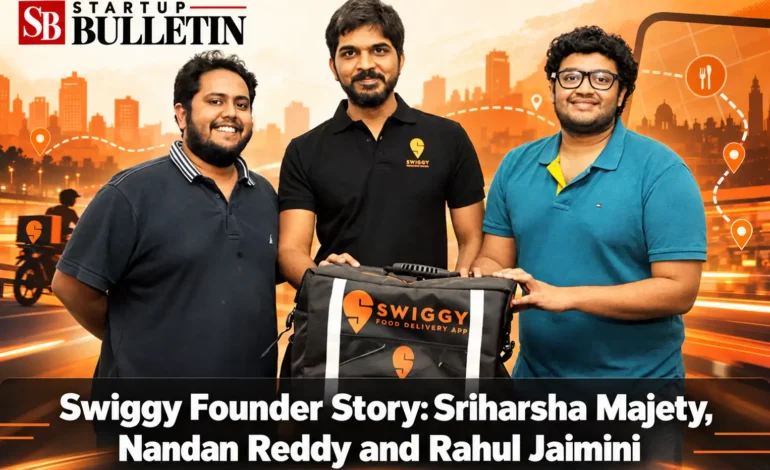
Swiggy Founder Story: Sriharsha Majety, Nandan Reddy and Rahul Jaimini

Swiggy was originally founded in 2014 by Sriharsha Majety, Nandan Reddy and Rahul Jaimini. Majety and Reddy had first worked together on Bundl, a logistics venture that they shut down when it failed to gain enough traction. They then moved toward hyperlocal urban delivery and brought in Jaimini as the technology co-founder. Swiggy launched food delivery in Bengaluru’s Koramangala area in August 2014.
There is one important qualification. In July 2021, Swiggy elevated early employee Phani Kishan Addepalli to co-founder. Therefore, articles may show either the three original founders or a later leadership group that includes Phani. Both can be accurate when the timing is explained. Rahul Jaimini left day-to-day duties in 2020, and Nandan Reddy moved on from Swiggy in April 2026. Sriharsha Majety remains Managing Director and Group CEO, while Phani has continued in senior operating leadership.
Quick facts
| Key point | Research-based detail |
| Original founders | Sriharsha Majety, Nandan Reddy and Rahul Jaimini |
| Later elevated co-founder | Phani Kishan Addepalli, elevated in July 2021 after joining in 2015 |
| Founded / launched | Food-delivery operations launched in 2014 in Bengaluru |
| Earlier venture | Bundl, a B2B logistics marketplace started by Majety and Reddy and later wound down |
| Core difference | Swiggy built an on-demand delivery-partner network instead of depending only on restaurant delivery |
| Quick commerce | Swiggy launched quick commerce in 2020 under Instamart |
| IPO listing | 13 November 2024 on NSE and BSE; NSE described the public issue as about ₹11,327.43 crore |
| Current leadership note | Majety is Group CEO; Jaimini left daily operations in 2020 and Reddy left Swiggy in April 2026 |
Swiggy’s founder and co-founder roles
| Name | Founding / leadership contribution | Status explained |
| Sriharsha Majety | Co-created Bundl, co-founded Swiggy and led the group | Managing Director and Group CEO |
| Nandan Reddy | Co-created Bundl and helped shape Swiggy’s early operations and new bets | Moved on from Swiggy in April 2026 |
| Rahul Jaimini | Original technology co-founder; built the early apps and engineering backbone | Left day-to-day duties in May 2020 |
| Phani Kishan Addepalli | Joined in 2015, built several functions and was elevated to co-founder | Co-founder title announced in July 2021 |
Key timeline
| Year / date | What happened | Why it matters |
| 2013–14 | Majety and Reddy built and wound down Bundl. | The failed logistics venture created useful operating insight. |
| Aug 2014 | Swiggy launched in Koramangala, Bengaluru. | The company began with a focused neighbourhood food-delivery model. |
| Apr 2015 | Swiggy raised a reported $2 million from SAIF and Accel. | Early institutional capital supported city expansion. |
| May 2020 | Rahul Jaimini left day-to-day Swiggy responsibilities. | His departure marked a change from the original operating trio. |
| 2020–22 | Instamart launched in 2020; Dineout joined in 2022. | Swiggy expanded beyond restaurant delivery. |
| Jul 2021 | Phani Kishan was elevated to co-founder. | The title recognised his long-term role in building the company. |
| 13 Nov 2024 | Swiggy shares listed on NSE and BSE. | The IPO moved Swiggy from a private startup to a listed company. |
| Apr 2026 | Nandan Reddy moved on from Swiggy. | Sriharsha Majety described it as the end of an era. |
The failure that came before Swiggy
Sriharsha Majety and Nandan Reddy did not begin with food. Their earlier company, Bundl, attempted to connect businesses with courier and logistics providers. The idea exposed them to supply networks and fulfilment, but it did not find enough momentum. They shut it down in 2014. That experience is central to the Swiggy founder story because the next company was not an unrelated lucky idea; it was a sharper use of lessons from a failed logistics marketplace.
The founders saw that local restaurants often lacked dependable delivery. Listing a menu online was not enough if the meal arrived late, cold or not at all. Swiggy’s model would control more of the service by arranging its own on-demand delivery partners. This made the business harder and more expensive than a simple directory, but it also gave the company a chance to offer a more consistent customer experience.
Finding the technology co-founder
Majety and Reddy needed an engineer who could build for customers, restaurants and delivery partners. Swiggy’s official farewell note for Rahul Jaimini says the two founders were using contractors at Bundl and actively looking for a technology co-founder. After an initially missed connection, they met the correct Rahul Jaimini in 2014 and convinced him to join their urban-delivery idea.
Jaimini’s contribution went beyond a consumer app. The platform needed order routing, restaurant tools, delivery-partner software, live tracking and systems that could cope with demand spikes. Majety later wrote that Swiggy grew from about 100 daily orders on a website-only product to 15,000 daily orders in six months, while Jaimini and a small team built the required suite of apps. The figure comes from Swiggy’s own account and should be read as a company statement.
Launching in one Bengaluru neighbourhood
Swiggy began in Koramangala, a dense Bengaluru neighbourhood with restaurants, offices, young consumers and a strong startup community. A small launch area allowed the founders to learn delivery times, restaurant behaviour and customer demand without spreading the team too thin. Hyperlocal businesses depend on density: if restaurants, riders and customers are too far apart, the waiting time and cost rise quickly.
The company’s early product promise was reliability. Customers could browse menus, place an order and track it, while Swiggy coordinated the last mile. Restaurants gained access to delivery capacity without building a large fleet. Delivery partners gained a flow of orders. Each side benefited only if the other two were present, so the founders had to build a three-sided network rather than a conventional online store.
Why owning the delivery experience mattered
Earlier food-ordering services often depended on restaurants to deliver. That approach required less capital, but it gave the platform limited control after an order was placed. Swiggy chose to organise delivery through its own partner network. The model improved visibility and created a more consistent promise, while also adding recruitment, training, incentives, support and safety responsibilities.
This operating choice became an important advantage. A customer could order from a restaurant that did not have its own delivery staff. The company also collected data about preparation and travel times, which could improve estimates and matching. However, a delivery network is expensive to build. The founders needed enough orders in each area to keep partners productive without making customers wait. Balancing that marketplace became one of Swiggy’s core capabilities.
Early funding and expansion
In April 2015, established reports said Swiggy raised about $2 million from SAIF Partners and Accel. Contemporary coverage identified Majety, Reddy and Jaimini as the three founders and described the company as an eight-month-old Bengaluru startup. Swiggy raised more capital later, but the first institutional round is useful because it came after the team had demonstrated a functioning local service rather than only presenting a broad national plan.
Expansion brought new problems. Every city has different restaurant clusters, traffic patterns, customer habits and labour conditions. A food-delivery platform cannot copy a launch checklist without local adaptation. Swiggy needed city teams, support systems and restaurant sales while maintaining one consistent product. Growth was therefore an operating exercise as much as a marketing campaign.
From food delivery to on-demand convenience
Swiggy gradually widened its scope. Its official corporate material says food delivery launched in 2014 and quick commerce in 2020. Instamart applied the delivery network to groceries and daily-use products, using local fulfilment infrastructure to serve short time windows. Swiggy also added Genie for pick-up and drop-off services and acquired Dineout in 2022, extending the group into dining reservations and offers.
These moves changed the company from a restaurant-delivery specialist into an on-demand convenience platform. The logic was that a consumer who trusts Swiggy for food may use the same app for other frequent needs. The risk is complexity: groceries, restaurant meals and reservations have different economics and operational demands. A strong group must share technology and customers without assuming that every category works in the same way.
Founder departures and the Phani Kishan distinction
Rahul Jaimini left daily responsibilities in May 2020 to pursue a role at Pesto. Swiggy’s announcement said he would remain a board member and shareholder at that time. In July 2021, the company elevated Phani Kishan Addepalli to co-founder. Majety wrote that Phani had joined in 2015 and had built multiple functions from the ground up. Calling Phani an original 2014 founder would be inaccurate; calling him a Swiggy co-founder after the 2021 elevation is accurate.
Nandan Reddy remained an important co-founder for more than a decade. On 14 April 2026, Swiggy published Majety’s note announcing that Reddy would move on to explore unrelated areas. The message credited him with helping shape food delivery, early quick-commerce work and the Dineout bet. These transitions show why founder titles need dates and context rather than a single static list.
The 2024 IPO
Swiggy’s shares listed on the National Stock Exchange and BSE on 13 November 2024. NSE’s listing-event page described the public issue as approximately ₹11,327.43 crore. The company’s prospectus and regulatory filings provide the authoritative detail on the offer, risk factors, shareholding and historical financial information. The listing was a major transition because public shareholders now expected regular disclosure and governance from a company built in the fast-moving private startup market.
An IPO is not the end of a founder story and does not automatically prove profitability. It gives investors a way to own and trade shares while providing capital and liquidity under the terms of the offer. Swiggy still has to balance growth, customer value, partner earnings and financial discipline. The public-company phase makes those trade-offs more visible.
Where Swiggy stands in 2026
Swiggy’s 2026 corporate releases identify Sriharsha Majety as Managing Director and Group CEO. The company says its food-delivery network works with more than 2.7 lakh restaurants across over 720 cities. Those are company-reported, time-sensitive figures rather than permanent facts. Current reach should always be checked in the latest annual report or corporate release.
The founder story is now a story of institution building. The original team established the model, later leaders expanded categories, and public-market governance must support the next phase. Swiggy’s long-term quality will depend on whether its services can grow with strong customer retention, healthy partner economics and controlled losses, not simply on order volume or city count.
Lessons for startup founders
The first lesson is to learn from a failed company without copying it. Bundl did not work, but its logistics lessons helped shape Swiggy. The second is to control the part of the experience that defines customer trust. Swiggy accepted the complexity of delivery because the last mile determined whether the meal arrived reliably. The third is to launch within a dense, manageable area before pursuing a national map.
The fourth lesson is to credit evolving leadership accurately. Jaimini was an original founder, Phani was elevated later, and Reddy’s 2026 departure does not erase his founding role. Finally, funding and an IPO are tools, not proof of a finished business. The enduring achievement is building an operating system that customers, restaurants and delivery partners choose repeatedly.
Frequently asked questions
Who is the founder of Swiggy?
Swiggy’s original founders are Sriharsha Majety, Nandan Reddy and Rahul Jaimini.
Is Phani Kishan a Swiggy co-founder?
Yes. Swiggy elevated Phani Kishan Addepalli to co-founder in July 2021. He was not part of the original 2014 founding trio.
When did Swiggy start?
Swiggy launched food-delivery operations in Bengaluru in 2014.
What was Bundl?
Bundl was the earlier B2B logistics marketplace created by Majety and Reddy. They wound it down before building Swiggy.
Did Rahul Jaimini leave Swiggy?
He left day-to-day Swiggy responsibilities in May 2020. Swiggy said at the time that he would remain a board member and shareholder.
When did Swiggy become a public company?
Swiggy’s shares listed on NSE and BSE on 13 November 2024.
Is Nandan Reddy still at Swiggy?
Swiggy announced in April 2026 that Reddy would move on from the company.
Information disclaimer
This article was prepared from publicly available company pages, official filings, investor documents, historical references and reputable media reports. Some information is therefore sourced from third parties. Funding, revenue, GMV, valuation, market reach, ownership, executive roles and operating metrics can change, and a reported figure may not be audited. Company statements, plans and targets are identified as such and should not be treated as independently verified results. Please cross-check important information with the latest official filing before making an investment, business, legal or purchasing decision. This article is for general information and is not professional advice. If you notice an error or have a credible correction, please email contact@startupbulletin.in.