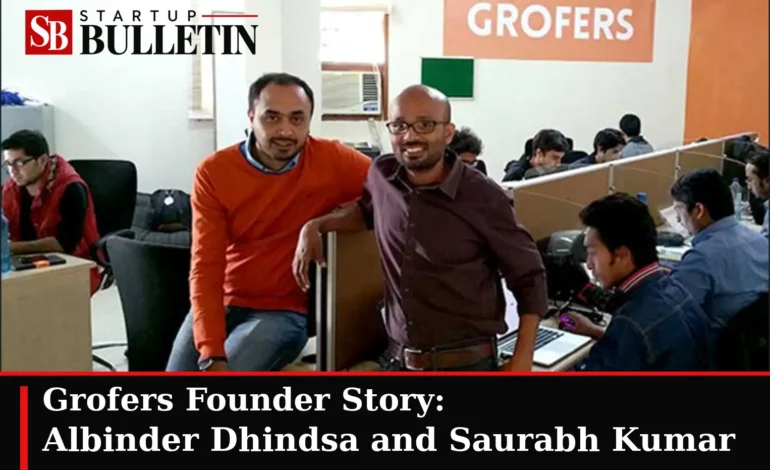
Grofers Founder Story: Albinder Dhindsa and Saurabh Kumar

Grofers was founded in December 2013 by Albinder Dhindsa and Saurabh Kumar. The official Blinkit press page identifies both men as the founders of the business that later became Blinkit. The original idea was not the same ten-minute grocery model known today. It began as a local logistics service that helped merchants fulfil orders and then developed into a consumer grocery marketplace.
The Grofers founder story is important because it contains several changes of direction. The company moved from a merchant-delivery network to online grocery, expanded aggressively, pulled back from some cities, experimented with inventory and private labels, and later pivoted to quick commerce. Saurabh Kumar left operating duties in June 2021. In December 2021, Grofers changed its consumer brand to Blinkit under Albinder Dhindsa’s leadership. Therefore, Grofers and Blinkit should not be written as two unrelated startups.
| Key point | Research-based detail |
|---|---|
| Founders | Albinder Dhindsa and Saurabh Kumar |
| Founded | December 2013 |
| Starting market | Gurugram / Delhi NCR |
| Original idea | Hyperlocal logistics and order fulfilment for local merchants |
| Later focus | Online grocery and household essentials |
| Saurabh Kumar transition | Left the company in June 2021; reports said he remained a shareholder and board member at that time |
| Rebrand | Grofers announced the Blinkit name in December 2021 |
| Current identity | The business continues as Blinkit, owned by Blink Commerce Private Limited within Eternal |
The Grofers founding team
| Founder | Early contribution | Later development |
|---|---|---|
| Albinder Dhindsa | Joined full-time as co-founder; led business, strategy and later quick-commerce pivot | Led Blinkit and became Group CEO of Eternal in February 2026 |
| Saurabh Kumar | Started the original local-logistics idea and built early operations | Left day-to-day work in June 2021 and later launched Warpli |
Key timeline
| Year / date | What happened | Why it matters |
|---|---|---|
| Dec 2013 | Dhindsa and Kumar began building the business that became Grofers. | The company first addressed local merchant fulfilment. |
| 2014 | Albinder Dhindsa joined the venture full-time as co-founder. | The founding team began moving toward a consumer-facing model. |
| 2015–16 | Grofers raised capital and expanded, then withdrew from some markets. | The pullback showed the cost of scaling hyperlocal delivery too quickly. |
| 2020 | Pandemic demand increased online-grocery adoption. | Grofers gained new users but also faced supply and fulfilment pressure. |
| Jun 2021 | Saurabh Kumar left operating duties. | Albinder Dhindsa continued to lead the company. |
| Dec 2021 | Grofers became Blinkit. | The new name marked the strategic shift toward instant commerce. |
| Aug 2022 | Zomato completed its acquisition of Blinkit. | The former Grofers business became part of a listed technology group. |
How the two founders met
Albinder Dhindsa and Saurabh Kumar knew each other before Grofers and had worked at Cambridge Systematics. Kumar began experimenting with local delivery infrastructure, while Dhindsa was working at Zomato and later joined full-time. In a 2014 interview, Dhindsa said the pair had started working on the idea in December 2013 with the intention that he would eventually come on board.
Their first insight was that local shops could sell more effectively if someone solved the logistics layer. A merchant might receive an order but lack reliable technology, picking and delivery. Rather than building a warehouse from the first day, the team tried to connect neighbourhood supply with customers. This asset-light idea was attractive, but it depended on coordinating stores whose catalogues, inventory and processes were not standardised.
From B2B logistics to a consumer grocery app
The early company supported delivery for local businesses, but the founders saw stronger potential in a consumer-facing grocery service. Grofers began allowing users to browse products and place orders through an app while the company coordinated fulfilment from local merchants. The brand name combined the idea of groceries with gophers—helpers who fetch things—although the exact branding was less important than the convenience promise.
The marketplace model solved a discovery problem but created an inventory problem. A customer might see an item that a partner shop no longer had. Product names and pack sizes could differ, and substitutions created frustration. Grofers had to improve cataloguing, merchant systems, picking and delivery simultaneously. These operational difficulties explain why online grocery is much harder than adding products to an app.
Rapid expansion and the 2016 reset
Investor interest helped Grofers enter multiple cities quickly. Growth increased brand awareness, but local fulfilment economics varied. In 2016, the company pulled back from several cities and adjusted its model. Business Standard later reported that Grofers had to scale down operations in nine cities after two years of hyper-growth because the business was losing too much money.
The reset is one of the most useful parts of the Grofers success story. A startup can gain downloads and orders without creating a repeatable local business. Grocery has low margins, customers are price-sensitive and each missed item adds support cost. The founders had to decide where density was strong enough to continue and where expansion had moved ahead of product-market fit.
Building greater control over supply
Over time, Grofers moved toward models that offered more control over stock, fulfilment and product economics. Warehouses, dark stores and private-label products can improve availability and margins, but they also require working capital and forecasting. When a company owns or holds more inventory, it must predict demand and manage expiry, damage and waste.
This evolution changed Grofers from a pure connector into a deeper retail and supply-chain business. The app remained visible to customers, while the hard work moved behind the screen: procurement, assortment, inventory placement, picking and routing. The founder lesson is that a marketplace may need to own more of the operation when quality cannot be guaranteed through loose coordination alone.
The pandemic period
COVID-19 lockdowns accelerated interest in online grocery because many households wanted essentials delivered. Grofers experienced stronger demand, but the period was not an effortless windfall. Movement restrictions, supply shortages, health protocols and sudden order spikes made fulfilment difficult. The company had to protect workers, communicate delays and keep essential items available.
The period strengthened the habit of buying groceries online and increased the strategic value of local fulfilment. It also showed that customers cared about reliability as much as discounts. A grocery order is not successful if several important items are missing. The operating knowledge built during this period later supported the move toward faster delivery.
Saurabh Kumar’s 2021 exit
In June 2021, Saurabh Kumar left his active role at Grofers. Contemporary reports quoted Albinder Dhindsa saying Kumar would remain a board member and shareholder at that time. Kumar later launched Warpli, an e-commerce venture. His departure came before the public rebrand to Blinkit, so it is inaccurate to describe him as the executive who led the new brand’s later growth.
It is equally inaccurate to remove him from the history. Blinkit’s own press page says Kumar and Dhindsa founded the company in December 2013. A careful article therefore distinguishes founding credit from later operating leadership: both men founded Grofers, while Dhindsa led the quick-commerce transition and remained the main public leader after Kumar’s exit.
Why Grofers became Blinkit
On 12 December 2021, Albinder Dhindsa published a company post announcing the Blinkit identity; news coverage followed on 13 December. The message said the team was repurposing Grofers’ learnings and infrastructure for quick commerce. The new name was designed to communicate speed—delivery in the blink of an eye—more clearly than the grocery-specific Grofers brand.
A rebrand does not create a new company by itself. The people, technology, licences, supply chain and history continued. What changed was the consumer promise and operating model. Dark stores placed inventory closer to customers, while software coordinated picking and delivery within smaller local areas. The name change was therefore a visible sign of a deeper strategic pivot.
Grofers versus Blinkit: the correct relationship
Grofers is the former brand name of the business now known as Blinkit. The official app listing still describes Blinkit as “formerly Grofers,” and Blinkit’s corporate information states that Blink Commerce Private Limited was formerly Grofers India Private Limited. This continuity matters for readers comparing founder articles, funding histories or acquisition reports.
The search term “Grofers founder” should lead to Albinder Dhindsa and Saurabh Kumar. The search term “Blinkit founder” should also acknowledge both founders, while explaining that Dhindsa led the Blinkit-era operating journey and Saurabh had already left daily work. That wording preserves historical accuracy without implying that both men held the same role throughout every phase.
The Zomato transaction and later ownership
Zomato’s board approved an all-stock acquisition of Blinkit in June 2022 for a stated purchase consideration of about ₹4,447.48 crore. Zomato said the transaction closed on 10 August 2022. Because the company had already changed its consumer brand, the acquired business was reported as Blinkit, but its history included the full Grofers journey.
Zomato later changed its corporate name to Eternal, and Blinkit operates within that listed group. Ownership changed, but the operating challenge remained: place the right inventory near customers, pick accurately and deliver reliably while controlling cost. The acquisition is therefore a major financial milestone, not a substitute for the everyday retail system.
Lessons from the Grofers founder journey
The first lesson is that a startup may need several business-model changes before it finds the strongest use case. The second is that fast expansion can hide weak local economics. Grofers’ 2016 pullback was painful, but it forced more disciplined choices. The third is that a rebrand works best when it reflects a real change in product and operations, not only a new logo.
The final lesson is to preserve accurate founding history through leadership changes. Saurabh Kumar’s exit does not remove his role in creating Grofers, and Albinder Dhindsa’s later leadership deserves separate recognition. The complete story is stronger than a simplified single-founder narrative because it shows how different people influenced different stages of the same company.
Frequently asked questions
Grofers was co-founded by Albinder Dhindsa and Saurabh Kumar in December 2013.
Yes. Grofers changed its consumer brand to Blinkit in December 2021 as it focused on quick commerce.
Yes. He left active duties in June 2021; reports said he remained a board member and shareholder at that time.
The official Blinkit press page traces the business to December 2013.
The Blinkit name reflected the company’s pivot from scheduled online grocery to much faster instant-commerce delivery.
Zomato acquired Blinkit in an all-stock transaction that closed in August 2022. Zomato’s listed parent later became Eternal.
Information disclaimer
This article was prepared from publicly available company pages, official filings, investor documents, historical references and reputable media reports. Some information is therefore sourced from third parties. Funding, revenue, GMV, valuation, market reach, ownership, executive roles and operating metrics can change, and a reported figure may not be audited. Company statements, plans and targets are identified as such and should not be treated as independently verified results. Please cross-check important information with the latest official filing before making an investment, business, legal or purchasing decision. This article is for general information and is not professional advice. If you notice an error or have a credible correction, please email contact@startupbulletin.in.