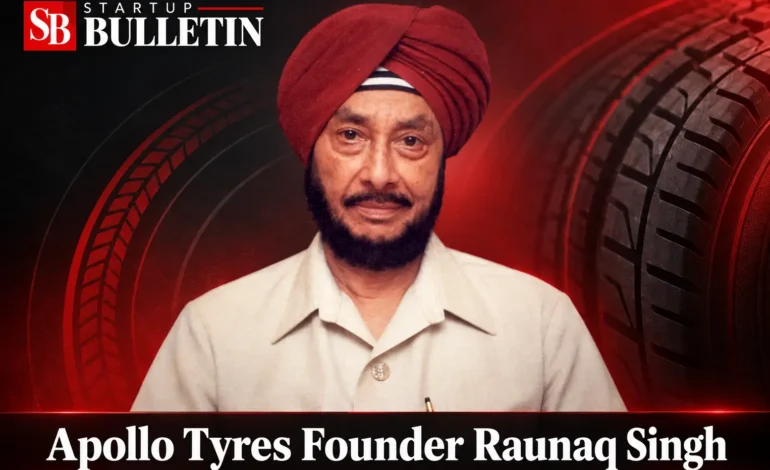
Apollo Tyres Founder Raunaq Singh Success Story

Raunaq Singh was the founder associated with Apollo Tyres, which came into existence in 1972. He built the business during a period when India’s manufacturing sector was developing under difficult capital, technology and distribution conditions. Apollo’s growth from an Indian tyre company into an international group shows how industrial businesses are built over decades, not through one funding round or one product launch.
| Key point | Verified detail |
|---|---|
| Founder | Raunaq Singh |
| Company | Apollo Tyres Limited |
| Inception | 1972 |
| Industry | Tyres and mobility products |
| Early manufacturing milestone | Apollo’s first plant was established at Perambra, Kerala |
| International milestone | Acquisition of Vredestein Banden in 2009 |
Raunaq Singh’s business background
Raunaq Singh began with business interests in steel and industrial products before building the group associated with Apollo. His experience was rooted in manufacturing and infrastructure rather than consumer internet. That background shaped the way Apollo was built: through plants, production capability, quality systems and distribution relationships.
Apollo Tyres was incorporated in 1972. The company entered a market where established manufacturers already had plants and customer relationships. A new company had to compete through product quality, capacity, dealer relationships and the ability to serve commercial vehicle owners whose businesses depend on reliable tyres.
Building the first manufacturing base
Apollo’s early manufacturing story is associated with the Perambra plant in Kerala. Establishing a tyre plant requires large capital investment, engineering capability, raw materials, testing and a stable workforce. It is very different from launching a digital product because the cost of a mistake can be high and expansion takes time.
The company used manufacturing scale and product development to enter commercial and passenger-vehicle segments. Tyres are safety-critical products, so reliability and performance are central to the brand. A founder in this industry must build trust not only with end consumers but also with vehicle makers, dealers, fleet operators and service networks.
Challenges and long-term expansion
Apollo Tyres faced economic and political difficulties during its history, including a period when the company was nationalised in the late 1970s according to corporate historical material. Such events show the external risk industrial founders must manage. Business plans can be affected by government policy, raw-material prices, currency movement, labour conditions and demand cycles.
The company later expanded beyond India. In 2009, Apollo acquired the Netherlands-based Vredestein Banden, later known as Apollo Vredestein B.V. The acquisition gave Apollo an international platform and a stronger position in premium and European markets. International growth also brings new regulatory, technology and brand-management responsibilities.
The leadership transition
Raunaq Singh later passed the business to the next generation, including his son Onkar Kanwar. This is a reminder that a founder’s role changes as a company becomes an institution. The founder may establish the vision and first manufacturing base, while later leaders build global operations, professional management and new technology capabilities.
Apollo Tyres today is a much larger organisation than the company launched in 1972. Its present performance should not be credited only to one person; it reflects the work of employees, suppliers, dealers and successive management teams. At the same time, Raunaq Singh’s original decision to build a tyre company created the platform on which that later growth became possible.
Lessons from Raunaq Singh’s journey
The first lesson is patience. Industrial businesses need years of investment before they can achieve meaningful scale. The second is that manufacturing capability can be a strategic advantage when it is matched with quality and distribution. The third is to think beyond the first market. Apollo’s later international expansion shows how a company can use domestic experience as a base for global growth.
The Apollo Tyres story is therefore useful for founders in sectors where success is measured in plants, product reliability and long-term relationships rather than rapid user growth.
Frequently asked questions
Apollo Tyres was founded by Raunaq Singh and came into inception in 1972.
Apollo’s early manufacturing history is associated with its Perambra plant in Kerala.
Apollo acquired the Netherlands-based Vredestein Banden in 2009.
The company was later led by the next generation, including his son Onkar Kanwar, along with professional management.
Editorial disclaimer
This article is based on publicly available company information, official pages, historical references and media reports reviewed for this draft. Funding, revenue, valuation, user counts, future plans and product claims may change. A reported figure is not automatically an audited figure, and a company target is not a completed result. Readers should cross-check important information before making a business, investment or purchasing decision. If you find an error or have a credible correction, please email contact@startupbulletin.in.