Naman Pushp Success Story: From Teenage Drone Builder to Airbound Founder

When schools closed during the 2020 pandemic, Naman Pushp began building drones as a technical experiment. He was around 15 and had not yet planned to create an aerospace company.
That experiment gradually developed into Airbound, a Bengaluru startup building lightweight autonomous aircraft for commercial delivery. The company wants to make small-package logistics faster and less expensive by moving goods through the air instead of transporting heavy vehicles through traffic.
Airbound has since attracted investors including Lightspeed Venture Partners, Lachy Groom, Greenoaks, Humba Ventures and technology executives. It has also completed a medical-logistics pilot with Narayana Health.
The Naman Pushp success story combines an unusual early start with a difficult deep-tech challenge: designing, manufacturing and operating an aircraft that can deliver real goods safely and economically.
Naman Pushp and Airbound at a Glance
| Detail | Verified or reported information |
|---|---|
| Founder and CEO | Naman Pushp |
| Company | Airbound |
| Headquarters | Bengaluru, India |
| Sector | Aerospace, autonomous logistics and drone delivery |
| Early experiments | Began building drones around age 15 during 2020 |
| Company timeline | Sources variously use 2020 and 2023 as the founding year |
| Aircraft type | Blended-wing-body tailsitter |
| October 2025 seed round | $8.65 million |
| Reported 2026 Series A | $37 million |
| Confirmed valuation | Not publicly disclosed |
| Major operating milestone | More than 700 medical-logistics flights in a Narayana Health pilot |
How Naman Pushp Started Building Drones
Pushp’s interest in drones developed during the lockdown, when he began experimenting with aircraft and robotics. Reports say an early drone project won a $500 prize, giving him a reason to continue.
The first designs did not immediately become a delivery network. Building an aircraft required Pushp to understand aerodynamics, weight, propulsion, materials and control systems. By the time investors encountered him, he had already spent substantial time developing a vertical-take-off-and-landing prototype.
Lightspeed says it met Pushp when he was 17. According to the investor, he had turned down admission to Carnegie Mellon University and spent a year building a VTOL prototype. Lightspeed later announced its investment in Airbound in November 2024.
The lesson from this stage of the Naman Pushp success story is straightforward: the visible startup came after years of technical experimentation.
When Was Airbound Founded?
Public sources do not use one consistent starting year. TechCrunch says Airbound was founded in 2020, when Pushp was 15. The Economic Times describes the startup as founded in 2023.
The difference may reflect two stages:
- 2020: Pushp began the project and built early drones.
- 2023: Airbound developed into a formal startup and began engaging more seriously with investors.
Because the reviewed sources do not provide a definitive legal-incorporation explanation, the article does not force one date into every reference.
Most major investor and funding coverage identifies Pushp as Airbound’s founder and CEO. Some startup databases also list Faraaz Baig, and one database names Yashi Pushp. These additional founder attributions were not confirmed through an accessible primary company source, so they should be treated cautiously.
What Problem Is Airbound Trying to Solve?
Traditional last-mile delivery uses a relatively heavy vehicle and a driver to move a small parcel. Pushp told TechCrunch that Indian electric two-wheelers can weigh around 150 kilograms even when carrying a package below three kilograms.
Airbound’s idea is to reduce the total mass required to move the package. A lightweight autonomous aircraft may consume less energy, avoid road congestion and operate without building an entirely new road network.
The company has discussed a long-term goal of reducing delivery energy costs to around 10 paise per kilometre and eventually enabling approximately one-cent delivery. These are company ambitions, not independently verified commercial prices currently available at scale.
How Airbound’s Aircraft Works
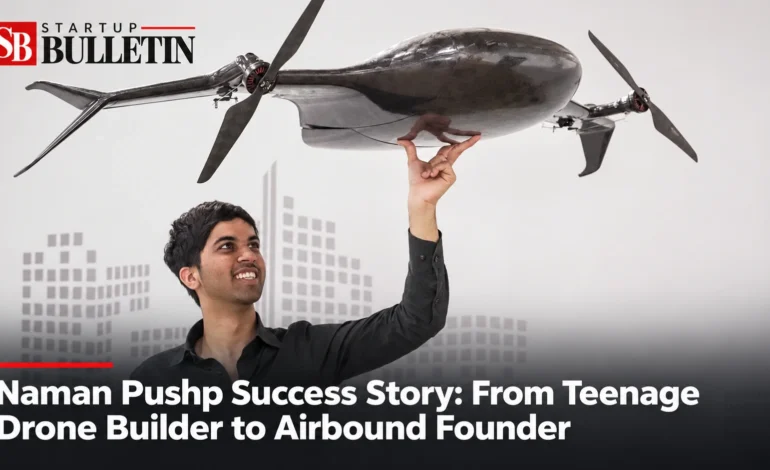
Airbound uses a blended-wing-body tailsitter design. The aircraft stands vertically for take-off and landing, then transitions into efficient forward flight like a fixed-wing plane.
| Design feature | Intended benefit |
|---|---|
| Vertical take-off and landing | Operates without a conventional runway |
| Fixed-wing forward flight | Uses less energy than hovering for the complete journey |
| Blended-wing body | Improves aerodynamic efficiency |
| Carbon-fibre construction | Reduces aircraft weight |
| Two-propeller configuration | Avoids the weight and drag of a standard quadcopter layout |
| Autonomous operation | Reduces dependence on a human driver for each parcel |
Airbound’s current website lists an aircraft weighing approximately 2.5 kilograms, carrying around one kilogram, with a stated range of roughly 40 kilometres and cruise speed of 60 kilometres per hour. These are company-published specifications and may vary by model, operating conditions and regulatory limits.
Airbound’s Funding Journey
| Stage | Amount | Investors reported |
|---|---|---|
| Early investment announced in 2024 | Amount not publicly disclosed in the reviewed source | Lightspeed Venture Partners |
| Seed round, October 2025 | $8.65 million | Led by Lachy Groom; Humba Ventures, Lightspeed and technology executives also participated |
| Series A, reported in 2026 | $37 million | Led by Greenoaks, with DoorDash, Lachy Groom, Lightspeed and Humba participating |
The $8.65 million seed round was reported by TechCrunch and The Economic Times. ET said the capital would support manufacturing scale and expansion across sectors.
Axios later reported a $37 million Series A led by Greenoaks. Adding the disclosed seed and Series A rounds gives $45.65 million, before considering earlier undisclosed capital. Some reports therefore describe total funding as nearly $50 million.
That number is funding, not valuation. A few secondary articles call Airbound a “$50 million startup,” but no reliable public source reviewed disclosed a confirmed post-money valuation.
Narayana Health Drone Pilot
Airbound’s partnership with Narayana Health provides a real-world test beyond prototypes and investor demonstrations.
The pilot connected Narayana Health’s Chandapura Clinic with its central laboratory at Narayana Health City in Bengaluru. According to completion coverage, the programme recorded:
- More than 700 flights across 54 consecutive operating days
- A four-kilometre aerial route completed in approximately 10 minutes
- Up to 40 diagnostic samples transported per flight
- Up to 20 flights per day
- Zero reported delivery failures during the pilot
Before aerial transport, samples were moved through limited road batches affected by Bengaluru traffic. Airbound’s flights allowed samples to reach the laboratory more continuously.
The partners plan further routes, subject to regulatory approvals. A successful controlled pilot is meaningful evidence of operational capability, but it does not yet prove that the same economics and reliability will hold across multiple cities and thousands of daily routes.
Airbound’s Opportunities and Risks
Airbound must also build reliable navigation, maintenance, monitoring and recovery systems. The aircraft itself is only one part of an operating delivery network.
| Opportunity | Related risk |
|---|---|
| Faster medical and small-parcel deliveries | Wider deployment requires regulatory permissions |
| Lightweight aircraft may reduce energy use | Hardware failures carry safety and reputational consequences |
| In-house component manufacturing can reduce cost | Scaling aerospace manufacturing requires strict quality control |
| Urban traffic creates demand for alternative logistics | Weather, noise and landing-space restrictions can limit routes |
| Large delivery platforms may become partners | Established drone and logistics companies may compete aggressively |
The Challenge of Manufacturing at Scale
Pushp has discussed a future in which producing 100 aircraft per day may eventually feel small. Reaching that point would require repeatable manufacturing, trained teams, dependable suppliers and strong testing systems.
A software product can often be distributed instantly after an update. Aerospace hardware must be manufactured, inspected, repaired and operated safely in the physical world. This makes Airbound’s opportunity significant but also capital intensive.
Lessons for Young Founders
- Start by building: Pushp developed prototypes before he had a polished startup story.
- Study the underlying physics: Airbound is trying to improve delivery economics by reducing weight and increasing aerodynamic efficiency.
- Use a demanding first market: Healthcare logistics requires reliability and provides a meaningful test of operational performance.
- Treat pilots as learning systems: Hundreds of flights can reveal issues that laboratory testing cannot.
- Separate ambition from proof: One-cent delivery and mass manufacturing are goals; completed flights are evidence.
- Funding is only an input: Safety, permissions, manufacturing quality and route economics will determine long-term success.
Is Airbound Already a Success Story?
Airbound has moved well beyond a school project. It has raised significant funding, built a specialised aircraft and completed hundreds of flights in a live healthcare environment.
However, verified revenue, profitability, commercial delivery volume and valuation have not been publicly disclosed. The company must still show that it can obtain wider approvals, manufacture aircraft consistently and operate profitable routes at scale.
The most accurate conclusion is that Naman Pushp has achieved unusual early technical and fundraising milestones, while Airbound remains a developing aerospace business with substantial execution risk.
Frequently Asked Questions
Naman Pushp is the founder and CEO of Airbound, a Bengaluru-based aerospace startup developing autonomous aircraft for delivery.
Multiple reports say he began experimenting with drones around age 15 during the 2020 lockdown.
Airbound raised an $8.65 million seed round in 2025. Axios reported a further $37 million Series A in 2026. Including earlier undisclosed capital, secondary reports place total funding close to $50 million.
No reliable public source reviewed confirmed a $50 million valuation. The figure appears to be used in some articles for the company’s approximate total funding rather than a disclosed valuation.
Its tailsitter aircraft takes off vertically and then flies forward like a plane. The lightweight blended-wing-body design is intended to carry small packages with less energy than conventional delivery methods.
The Naman Pushp success story began with a teenager building drones during lockdown and grew into a serious attempt to redesign last-mile logistics.
Airbound’s investor backing and Narayana Health pilot show that the idea has progressed beyond an experiment. The company has demonstrated hundreds of medical-logistics flights and attracted capital for further development and manufacturing.
The next stage will be harder: regulatory expansion, safe high-volume production and sustainable delivery economics. If Airbound can solve those problems, Pushp’s early prototypes may become the foundation of a meaningful new logistics network.
This article is based on publicly available company information, investor statements and media reports reviewed. Some sources use different founding years and founder lists; those differences have been disclosed instead of presenting uncertain information as settled fact.
Aircraft specifications, cost targets and manufacturing ambitions originate from Airbound or its founder unless stated otherwise. Funding figures are not the same as valuation or revenue. Startup information can change quickly, and readers should independently verify financial, operational, regulatory and investment information.
If you find an error or have updated supporting documents, please contact us, so we can review and correct the article.