Aravind Mani Success Story: How River Built India’s Utility Electric Scooter

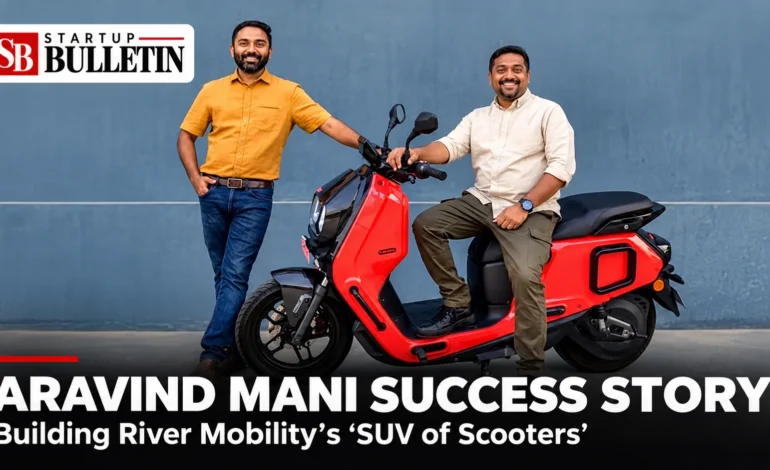
India’s electric-scooter market already had well-funded brands when Aravind Mani and Vipin George started River. Instead of building another conventional commuter scooter, they looked for a narrower problem: people wanted a two-wheeler that was practical enough for work and everyday transport without looking like a basic commercial vehicle.
That idea became the River Indie, a utility-focused electric scooter marketed as the “SUV of scooters.” Its design combines a large storage area, mounting options and a distinctive appearance.
River started delivering the Indie in October 2023. By August 2026, the Bengaluru company had raised a $120 million Series C round and was preparing to expand its product portfolio and manufacturing capacity.
The Aravind Mani success story is about identifying a specific gap in a crowded market and building the company, product and distribution network around it.
Aravind Mani and River at a Glance
| Detail | Verified or reported information |
|---|---|
| Co-founder and CEO | Aravind Mani |
| Co-founder and Chief Product Officer | Vipin George |
| Company | River Mobility |
| Founded | March 2021 |
| Headquarters | Bengaluru, Karnataka |
| Industry | Electric two-wheelers |
| Main product | River Indie |
| Product positioning | Utility-focused premium electric scooter |
| Deliveries began | October 2023 |
| Series B, 2024 | $40 million |
| Series C, August 2026 | $120 million |
| Sales reported through July 2026 | 27,533 units, based on Vahan data cited by Reuters |
| Publicly confirmed valuation | Not disclosed |
Aravind Mani’s Career Before River
Mani did not enter the EV industry as a college student with no work experience. Investor and industry profiles say he worked across manufacturing, petrochemicals and mobility before starting River.
Immediately before River, he served as Vice President of Operations and Strategy at electric-motorcycle company Ultraviolette Automotive. That experience gave him exposure to the practical difficulties of building an electric-vehicle business, including product development, suppliers, operations and manufacturing.
Vipin George brought complementary product-design experience and became River’s Chief Product Officer. George had previously worked in motorcycle and automotive design, including roles connected with Honda and Ultraviolette.
The founders’ different strengths shaped River’s structure: Mani focused on business and execution, while George led product and design.
Why Aravind Mani Started River
River was formed during the disruption created by the COVID-19 period. Mani has explained in interviews that he and George saw room for a lifestyle-oriented utility scooter.
Many Indian riders use two-wheelers for more than commuting. They carry bags, business supplies, groceries, tools and products. Delivery work and small businesses also require storage and flexibility. However, highly practical scooters can appear purely commercial, while stylish consumer models may not provide enough carrying capacity.
River’s founders tried to combine both sides of the market:
- Practical features for daily work and transport
- A design that individual owners would feel proud to use
- Electric power instead of a petrol engine
- A product built for Indian road and usage conditions
This “utility lifestyle” positioning became River’s main differentiator.
Building the River Indie
River spent its first 27 months on product development, prototypes and factory preparation, according to Mani. The first customer deliveries began in October 2023.
The Indie was designed around visible practical features rather than only software or acceleration figures.
| River Indie feature | Company-stated specification or purpose |
|---|---|
| Total storage | 55 litres, including under-seat storage and glovebox |
| Top speed | Up to 90 km/h |
| Battery | 4 kWh, IP67-rated |
| Claimed riding range | Varies by mode; company material has listed up to approximately 110–120 km |
| Wheels | 14-inch wheels |
| Utility features | Front foot pegs, pannier mounts and accessory options |
| Positioning | “SUV of scooters” |
These specifications come from River’s product material and may vary by model generation, software version, riding mode and real-world conditions. A claimed range should not be treated as a guarantee for every rider.
The scooter also received Red Dot recognition for Concept Design in 2024 and Product Design in 2025, according to River.
River’s Funding Journey
Vehicle companies require substantial capital. Before earning meaningful revenue, they must pay for engineering, tooling, components, factories, testing, certification, stores and service infrastructure.
| Funding stage | Amount reported | Selected investors |
|---|---|---|
| Early seed backing | $2 million | Maniv Mobility and Trucks Venture Capital |
| Funding round, 2022 | Approximately $11 million | Investors included Lowercarbon Capital, Toyota Ventures and others |
| Round led by Al-Futtaim, 2023 | $15 million | Al-Futtaim Automotive with existing investors |
| Series B, February 2024 | $40 million | Led by Yamaha Motor; existing investors also participated |
| Series C, August 2026 | $120 million | Led by Elev8 Venture Partners and Claypond Capital; Yamaha, Al-Futtaim and Mitsui also participated |
River said its $40 million Series B took cumulative funding to $68 million at that time. The 2026 Series C included more than 85% equity, with the remainder structured as debt, according to Reuters.
Funding is not the same as valuation, revenue or profit. River’s post-Series-C valuation was not disclosed in the reliable public sources reviewed for this article.
What the $120 Million Series C Will Fund
River plans to use the capital to expand its Karnataka manufacturing operations and construct another plant.
Reuters reported that the proposed new facility is designed for capacity of up to 80,000 scooters per month, compared with approximately 10,000 per month at the existing facility.
The 80,000 figure is planned manufacturing capacity—not current production, sales or demand. Building a factory does not automatically mean it will operate at full capacity.
River is also developing more products. Mani told Reuters that the company plans to introduce a second premium utility electric scooter by mid-2027 and is developing a third model.
River Indie Sales and Revenue
Reuters cited India’s Vahan vehicle-registration portal to report that River sold 27,533 Indie scooters through July 2026. The company had sold approximately 28,000 units during 2025 and expected its annual sales to more than double—or potentially triple—in 2026.
The double-or-triple figure is a management expectation, not a completed annual result.
River reported revenue of around ₹100 crore in FY2025. Mani said revenue more than quadrupled in FY2026, but the exact figure was not disclosed because the accounts were still being audited when Reuters published its report.
For this reason, the article does not calculate an unofficial FY2026 revenue number. It also does not claim that River is profitable, because verified profitability information was not publicly available in the reviewed sources.
Why River’s Strategy Is Different
River entered a market where Ather Energy, TVS Motor and Bajaj Auto already had stronger distribution and substantially larger sales volumes.
Instead of competing only on price, River has focused on a recognisable product category and controlled expansion.
| Strategic choice | Possible advantage | Related risk |
|---|---|---|
| Utility-lifestyle positioning | Makes Indie easier to distinguish | The segment may remain smaller than mass commuting |
| One core model during the early stage | Concentrates engineering and service resources | Dependence on one product increases business risk |
| Physical retail expansion | Builds trust and enables test rides | Stores and service centres require capital |
| In-house product and design focus | Creates a clearer brand identity | Automotive development is expensive and slow |
| Premium positioning | May support better margins | Price-sensitive buyers have many alternatives |
The approach can work only if product quality, service availability and parts support improve as sales grow. A strong design may attract buyers, but long-term trust in an automobile brand depends heavily on ownership experience.
The Manufacturing and Service Challenge
Scaling an EV company involves more than producing additional scooters. River must manage battery sourcing, electronic components, quality control, supplier consistency, warranty claims, software updates and trained service teams.
A rapid expansion can create problems if sales grow faster than service capacity. River will therefore need to balance its factory plans with dealership and after-sales growth.
The competitive pressure is also significant. Established manufacturers can use wider dealer networks, brand recognition and purchasing scale. Specialist EV companies may innovate faster but have fewer resources when problems appear across many cities.
Lessons from the Aravind Mani Success Story
- Experience can become a founder advantage: Mani entered River after working in manufacturing and electric mobility.
- Find a clear market gap: River did not position Indie as just another electric commuter scooter.
- Product design can support business strategy: Storage, mounting points and appearance all reinforce the utility-lifestyle category.
- Take time before launching: River spent more than two years on development and production preparation.
- Separate capacity from sales: A factory’s maximum capacity does not prove customer demand.
- Expand service with distribution: Vehicle sales create a long-term responsibility for repairs, parts and customer support.
- Funding is only an input: River must convert capital into reliable products, repeat customers and sustainable economics.
Is River Mobility Already a Success Story?
River has achieved meaningful milestones. It developed an original product, moved from prototypes to customer deliveries, attracted global automotive investors and recorded tens of thousands of registrations.
The $120 million Series C gives the company resources to expand manufacturing and build a broader product portfolio. Its Red Dot recognition and Indie’s distinctive positioning have also helped the brand stand out.
However, River remains much smaller than India’s leading electric two-wheeler manufacturers. Its valuation and profitability have not been publicly confirmed, while the new plant and future models are still plans.
The balanced conclusion is that River is a credible rising EV manufacturer—not yet a proven large-scale market leader. Its next phase will depend on product reliability, customer service, distribution, demand and capital discipline.
Frequently Asked Questions
Aravind Mani is the co-founder and CEO of River Mobility, a Bengaluru-based electric two-wheeler company.
Vipin George co-founded River and serves as its Chief Product Officer.
Reliable company and industry sources describe River as founded in March 2021. Some early coverage traces its formation work to late 2020, but March 2021 is the date River commonly uses.
The Indie is River’s utility-focused electric scooter. It combines everyday storage and carrying features with a consumer-oriented design.
River raised $120 million in a Series C round announced in August 2026. Elev8 Venture Partners and Claypond Capital led the round.
Reuters, citing Vahan registration data, reported 27,533 units sold through July 2026. Sales data may be revised as registrations are added or corrected.
River’s verified profitability was not publicly disclosed in the reliable sources reviewed for this article.
No reliable public source reviewed disclosed River’s post-Series-C valuation.
This article is based on publicly available company information, investor announcements, government registration data cited by Reuters and media reports reviewed. Product specifications, future sales expectations, factory capacity and launch schedules may change.
Funding is not the same as valuation, revenue or profitability. Company targets—including planned manufacturing capacity and future model launches—should not be treated as completed achievements. Readers should independently verify financial, product, investment and purchasing information.
If you find an error or have updated supporting documents, please email us. We will review credible corrections and update the article where necessary.