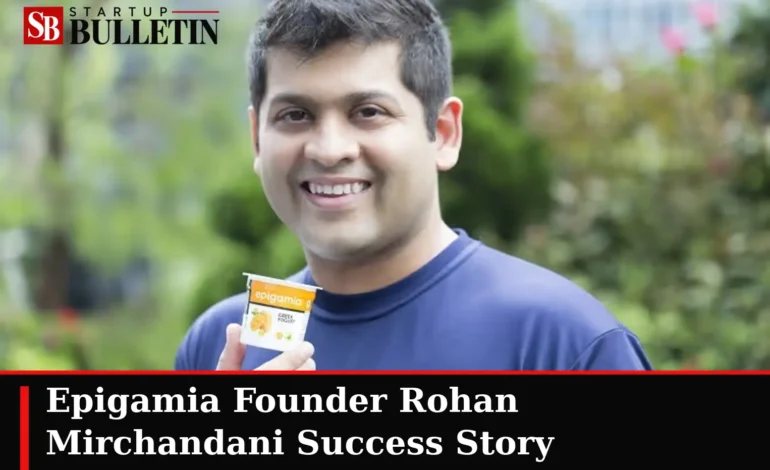
Epigamia Founder Story and the Team Behind the Brand

Epigamia was launched in 2015 by the team at Drums Food International. The four names most consistently identified with the Epigamia brand launch are Rohan Mirchandani, Uday Thakker, Rahul Jain and chef Ganesh Krishnamoorthy. Some databases also include Milap Shah in the earlier founding team of Drums Food. A careful Epigamia founder article should distinguish the parent company’s early history from the launch of the Epigamia brand.
Rohan Mirchandani became Epigamia’s best-known co-founder and long-time public leader. He helped move the business from premium ice cream under the Hokey Pokey name toward Greek yogurt and other modern dairy snacks. He died after a sudden cardiac arrest on 21 December 2024 at the age of 42. The company said its senior team would continue operations with support from the board and his family.
Epigamia made another leadership change in May 2026. Ritesh Gauba was appointed CEO, while Ankur Goel was elevated to co-founder and Chief Operating Officer after serving as a founding member and leading the business through the transition following Mirchandani’s death. This later elevation should not be confused with the original 2015 launch team.
| Key point | Research based detail |
|---|---|
| Brand | Epigamia |
| Operating company | Drums Food International Private Limited |
| Brand launch | June 2015 |
| Original brand founders commonly reported | Rohan Mirchandani, Uday Thakker, Rahul Jain and Ganesh Krishnamoorthy |
| Earlier parent company history | Some sources also identify Milap Shah in the early Drums Food founding team |
| Original focus | Greek yogurt positioned as a modern packaged snack |
| Headquarters | Mumbai, India |
| Rohan Mirchandani | Co-founder and long-time public leader; died on 21 December 2024 |
| 2026 CEO | Ritesh Gauba |
| 2026 co-founder and COO | Ankur Goel, elevated after years as a founding member |
The Epigamia founder and leadership names
| Name | Role in the story | Accuracy note |
|---|---|---|
| Rohan Mirchandani | Co-founder and the brand’s best-known early leader | Died in December 2024 |
| Uday Thakker | Co-founder and director | Helped steer the company after 2024 |
| Rahul Jain | Co-founder with operating and CEO experience | Later launched a separate deep-tech venture in 2026 |
| Ganesh Krishnamoorthy | Chef and co-founder linked to product development | Named in multiple brand histories |
| Milap Shah | Associated with the early Drums Food founding team | Not listed in every account of the 2015 brand launch |
| Ankur Goel | Founding member, then co-founder and COO from 2026 | Later elevation, not an original 2015 founder claim |
| Ritesh Gauba | CEO appointed in May 2026 | Professional CEO, not described as an original founder |
Key timeline
| Year or date | What happened | Why it matters |
|---|---|---|
| 2008 era | Drums Food began building a premium food business, first known for Hokey Pokey ice cream. | The parent company existed before the Epigamia brand. |
| Jun 2015 | Epigamia Greek yogurt launched. | The company shifted attention toward a repeat-purchase packaged dairy category. |
| 2018 onward | Strategic and consumer investors backed the company as distribution expanded. | External capital supported product and market growth. |
| 2023 | Rahul Jain was elevated to CEO while Rohan Mirchandani became executive chairman. | Leadership responsibilities were redistributed before the 2024 transition. |
| 21 Dec 2024 | Rohan Mirchandani died after a sudden cardiac arrest. | The company lost its best-known founder and entered a leadership transition. |
| 2025 to 2026 | Ankur Goel, Uday Thakker and the senior team led day-to-day continuity. | The company kept operating while formal leadership was rebuilt. |
| May 2026 | Ritesh Gauba became CEO and Ankur Goel became co-founder and COO. | The update clarified current management and recognised Goel’s long contribution. |
The company before Epigamia
The Epigamia founder story did not begin with yogurt. Drums Food International first operated in premium ice cream through Hokey Pokey. Accounts of the parent company’s beginning vary between 2007 and 2008, and some include Milap Shah alongside Rohan Mirchandani, Uday Thakker and chef Ganesh Krishnamoorthy. Because those sources differ, the safest fixed date for the consumer brand is Epigamia’s June 2015 launch.
Ice cream taught the team about cold-chain distribution, retail placement, flavours and Indian consumer preferences. It also exposed a limitation: ice cream can be seasonal and occasion-led. Yogurt offered the possibility of more frequent consumption. The team could use its dairy knowledge while entering a category associated with breakfast, snacking and everyday nutrition.
Rohan Mirchandani and the central founder role
Rohan Mirchandani grew up in the United States, worked in finance and studied at Wharton before committing to the Indian food business. He became the founder most closely associated with Epigamia’s strategy, fundraising and public identity. Interviews show him explaining the shift from ice cream to Greek yogurt and the need to combine health positioning with taste.
A founder profile should not turn his story into a lone-founder narrative. Uday Thakker, Rahul Jain and Ganesh Krishnamoorthy appear repeatedly in reliable accounts of the brand’s creation. Mirchandani’s visibility reflects his executive and spokesperson role, while the broader team contributed operations, product, finance and distribution experience.
Why Greek yogurt was a category bet
When Epigamia launched, Greek yogurt was far less familiar in India than regular curd. The product is strained, which changes its texture and concentration. Selling it required more than placing cups on a shelf. The company had to explain what the product was, why it tasted different and when customers might eat it. Packaging, sampling and cold availability were part of category education.
The bet was that urban consumers wanted convenient snacks that felt modern and offered a clearer nutrition proposition. Taste remained essential. A food brand does not create repeat purchase through claims alone. Flavours, texture, portion size, price and availability determine whether people buy again after the first trial.
How the founders built the product range
Epigamia expanded beyond its original Greek yogurt cups into smoothies, flavoured curd, milkshakes, lactose-free options and plant-based products at different points in its development. Not every product has the same customer or supply requirement. A wider portfolio can bring more shelf space and occasions, but it also makes manufacturing, forecasting and cold storage more complex.
Chef Ganesh Krishnamoorthy’s presence in the founding team is relevant because taste and formulation sit at the centre of a packaged-food company. Rahul Jain and Uday Thakker contributed to commercial and operating development. The business needed founders who could move between brand ideas and the less visible work of sourcing, production, quality checks and retail execution.
Cold chain and distribution
Yogurt is perishable. It must be produced consistently, kept within safe temperature ranges and moved through distributors and retailers before its shelf life expires. A national advertisement cannot compensate for empty refrigerators or damaged stock. Epigamia therefore had to build a distribution system that matched its marketing ambition.
The company initially concentrated on urban markets where premium retail and refrigerated distribution were more developed. Online grocery later became more important, especially during the pandemic. In 2021, Rohan Mirchandani told Mint that online sales had risen from roughly 4 to 4.5 percent before the pandemic to about 30 percent at that time. The number describes that period and should not be presented as the current channel mix.
Brand positioning and investor support
Epigamia used colourful packaging and a contemporary name rather than presenting itself as another traditional dairy label. The brand name refers to an ancient idea connected with marriage and union, but consumers mainly encountered it as a distinctive shelf identity. The design helped the products stand out in refrigerator cabinets where purchase decisions happen quickly.
The business attracted institutional and strategic investors as it expanded. Investors associated with the company have included DSG Consumer Partners, Verlinvest and Danone’s investment arm, while Deepika Padukone became a strategic investor and brand partner. Investment announcements show confidence and provide growth capital, but they do not by themselves prove profitability. Financial claims should be taken from filed statements or clearly attributed company disclosures.
Rohan Mirchandani’s death and company continuity
Drums Food confirmed that Rohan Mirchandani died after a sudden cardiac arrest on 21 December 2024. The company said senior leadership led by Ankur Goel, then COO and founding member, and Uday Thakker, co-founder and director, would continue daily operations with the board’s support. Reporting the event requires care because it affected a family, colleagues and a company still operating through grief.
The transition also tested whether Epigamia had become an institution rather than a founder-dependent project. Supply, manufacturing, payroll, retailer relationships and customer service had to continue. The board and leadership team kept the business running while considering the next formal structure.
The 2026 leadership structure
In May 2026, Epigamia appointed Ritesh Gauba as CEO and elevated Ankur Goel to co-founder and Chief Operating Officer. Reports said Goel had acted as the business head after December 2024 alongside Uday Thakker and growth head Ajinkya Poundrik. The company and its investor Verlinvest described FY2026 as a strong year for growth and profitability, but public articles should keep those statements attributed unless audited numbers are available.
The word co-founder can therefore refer to two moments in Epigamia’s history. Rohan Mirchandani, Uday Thakker, Rahul Jain and Ganesh Krishnamoorthy are most commonly named in the 2015 launch story. Ankur Goel received the title in 2026 after years as a founding member and senior operator. Stating both facts with dates avoids suggesting that he was newly recruited or that he was part of every original launch document.
Lessons from the Epigamia founder story
The first lesson is that category creation needs explanation and distribution at the same time. Customers must understand Greek yogurt, but they must also find a fresh cup nearby. The second lesson is that product quality drives repeat purchase. Packaging may win attention, while taste, texture and reliability determine whether a food brand becomes part of a routine.
The final lesson is leadership depth. Rohan Mirchandani was central to the company, yet Epigamia had to continue after his sudden death. Long-serving operators, co-founders, investors and the board provided continuity. The 2026 appointments show how a founder-led brand can move toward a broader management structure while preserving an accurate account of who built it.
Frequently asked questions
Epigamia’s 2015 launch is most commonly credited to Rohan Mirchandani, Uday Thakker, Rahul Jain and Ganesh Krishnamoorthy.
Some sources include Milap Shah in the early Drums Food founding team, but he is not listed in every account of the 2015 Epigamia brand launch.
The Greek yogurt brand launched in June 2015.
Drums Food said he died after a sudden cardiac arrest on 21 December 2024.
Ritesh Gauba was appointed CEO in May 2026.
He was a long-serving founding member and operator who was formally elevated to co-founder and COO in 2026.
Epigamia is operated by Drums Food International and has founders, their families and institutional investors among its stakeholders. Exact ownership should be checked in the latest filings.
This article was prepared from publicly available company pages, official filings, government records, historical references and reputable media reports. Some information is sourced from third parties. Funding, revenue, valuation, ownership, leadership roles, service coverage and operating metrics can change, and a reported figure may not be audited. Company statements, product claims, plans and targets are identified as such and should not be treated as independently verified results. Please cross-check important information with the latest official filing or company announcement before making an investment, business, legal, health or purchasing decision. This article is for general information and is not professional advice. If you notice an error or have a credible correction, please email contact@startupbulletin.in.