Python Founder Story of Guido van Rossum

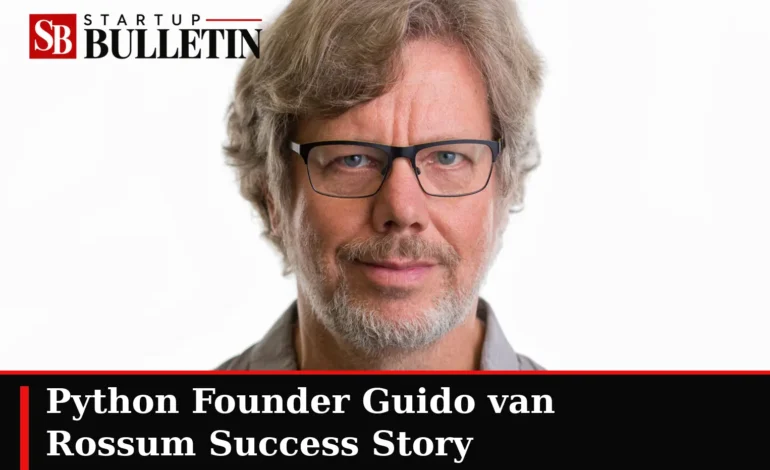
The person commonly called the Python founder is Guido van Rossum, a Dutch programmer who began implementing the language at CWI in Amsterdam in December 1989. The most precise title is Python’s creator rather than company founder, because Python is an open-source programming language and community project, not a startup owned by one individual. Van Rossum chose the name after the British comedy group Monty Python, not after the snake.
Python grew from ideas Van Rossum had encountered while working on ABC, an earlier language developed at CWI. He wanted a language that kept ABC’s readability and high-level approach while working better with the Unix and C environments used by professional programmers. Python 0.9.0 was posted publicly in February 1991. The early release already contained several ideas that remain familiar, including modules, functions, exceptions and core data types.
Van Rossum guided Python for decades and was known as its Benevolent Dictator For Life, or BDFL, a community term for the person who made final language-design decisions. He stepped down from that role in July 2018. Python now uses a five-member steering council under PEP 13, while the Python Software Foundation supports the language and its international community.
| Key point | Research based detail |
|---|---|
| Creator | Guido van Rossum |
| Work began | December 1989 at CWI in Amsterdam |
| First public release | Python 0.9.0 in February 1991 |
| Name origin | Monty Python’s Flying Circus |
| Important predecessor | ABC programming language |
| Early design aim | Readable high-level programming that also appealed to Unix and C users |
| Foundation | Python Software Foundation launched in March 2001 |
| Governance change | Van Rossum stepped down as BDFL in July 2018 |
| Current governance | Five-member steering council defined by PEP 13 |
| Latest career update | Van Rossum’s own resume says he retired from Microsoft in May 2026 |
People and institutions in the Python story
| Name or organisation | Contribution | Important distinction |
|---|---|---|
| Guido van Rossum | Designed and implemented the original language and led it for decades | Creator of Python, not the owner of today’s community project |
| CWI | Research institute where implementation began | Held rights to early Python releases |
| Python Software Foundation | Supports intellectual property, community, events and project resources | Non-profit formed in 2001 |
| Python core team | Maintains and develops CPython | Works under community governance |
| Steering council | Provides final project governance under PEP 13 | Five members elected for a term |
Key timeline
| Year or date | What happened | Why it matters |
|---|---|---|
| Dec 1989 | Van Rossum started implementing Python during the Christmas period. | The project began as a personal programming experiment at CWI. |
| Feb 1991 | Python 0.9.0 was posted to alt.sources. | The public release allowed outside programmers to use and improve it. |
| Jan 1994 | Python 1.0 was released. | The project moved from early 0.x versions into a stable public series. |
| 2000 | Python 2.0 was released. | The language entered a major new generation. |
| Mar 2001 | The Python Software Foundation was launched. | A non-profit structure began supporting the project and its assets. |
| Dec 2008 | Python 3.0 was released. | The language accepted compatibility costs to clean up long-term design issues. |
| Jul 2018 | Van Rossum resigned as BDFL. | Python had to replace single-leader governance. |
| 2019 onward | A steering council became the formal governance model. | Project authority shifted to an elected five-person council. |
| May 2026 | Van Rossum retired from Microsoft according to his resume. | His employment changed, while Python remained community governed. |
The Christmas project at CWI
In a foreword published on Python.org, Guido van Rossum wrote that he was looking for a hobby programming project in December 1989 while his Amsterdam office was closed for Christmas. He decided to write an interpreter for a scripting language he had been considering. The language would descend from ABC but appeal to programmers working with Unix and C. That first-person account is the strongest source for Python’s origin.
Calling Python a hobby project can make the work sound casual. Van Rossum already had professional experience in language design and implementation at CWI. He understood the useful parts of ABC and the reasons it had not spread widely among working developers. Python began with informed design choices, even though no company, large team or commercial launch stood behind its first version.
What Python borrowed from ABC
ABC was designed to be easy to read and suitable for teaching. It used indentation to express program structure, an idea Python retained. Van Rossum also wanted a practical extension system so programmers could connect Python with C code and operating-system tools. This combination helped Python feel approachable without isolating it from the systems professional developers already used.
Python’s syntax became one of its most visible features. Blocks are organised through indentation instead of braces. The language favours code that is easy to scan and gives programmers high-level data structures without forcing them to manage every low-level detail. These decisions did not make all Python programs automatically clear, but they created strong pressure toward readable source code.
Why the language is called Python
Van Rossum said he chose Python as a working title because he was a fan of Monty Python’s Flying Circus and wanted a short, slightly irreverent name. The name does not come from the snake. Snake imagery later became common in logos, books and conference jokes because readers naturally made the association.
The naming story is useful because it shows that a technical product does not need a literal name. Python was memorable, easy to say and broad enough to remain relevant as the language moved from scripting into web development, scientific computing, automation, education and artificial intelligence. The name stayed while the community and use cases expanded far beyond the original interpreter.
The first public release
Python 0.9.0 was posted to the alt.sources newsgroup in February 1991. Historical release notes preserved by Python describe that public posting and the patches that followed. Opening the code to outside users allowed Van Rossum to receive bug reports, feature ideas and contributions. The language could improve through actual use rather than only private design work.
Van Rossum later wrote that Python’s success belonged to a community that praised, criticised and extended the language. This is central to the Python founder story. One person created the original design and implementation, but thousands of contributors built libraries, documentation, tools, conferences and applications. Founder credit and community contribution can both be true without reducing either one.
Readability as a practical advantage
Python became popular partly because a beginner can read many programs without first decoding heavy punctuation. The interactive interpreter also gives immediate feedback, which is useful for learning and experimentation. Experienced teams value the same qualities when reviewing code, automating tasks or building prototypes. Programmer time can matter more than squeezing maximum speed from every line of an application.
The tradeoff is that Python is not the fastest choice for every workload. High-performance projects often move critical operations into C, C++, Rust, specialised libraries or accelerated hardware. Python remains valuable because it can coordinate those components through a simpler interface. Its strength is not one universal performance claim; it is the balance between development speed, readability and a broad ecosystem.
How Python reached a wider community
Python’s development followed Van Rossum through CWI, the Corporation for National Research Initiatives, BeOpen and other organisations. The language remained openly available, and its contributor base widened. Python 2.0 arrived in 2000. The Python Software Foundation launched in March 2001 to provide legal, financial and educational support and to hold project intellectual property.
The PSF does not employ or control every Python developer. It supports infrastructure, trademarks, grants, events and the broader community. CPython, the main implementation, is maintained through open development by a core team and other contributors. Companies can sponsor the ecosystem or employ core developers, but no single employer owns the language.
Python 3 and the cost of correcting design
Python 3.0 was released in December 2008 and deliberately broke compatibility with some Python 2 code. The change allowed the language to remove old behaviour and make long-term improvements, but migration took years. Many organisations depended on existing software and libraries, so Python 2 and Python 3 lived side by side for a long period.
This phase shows a difficult founder and community decision. Backward compatibility protects users, while permanent compatibility can trap a language in old choices. Python accepted short-term fragmentation to create a cleaner future platform. The transition was painful, and the project eventually ended official Python 2 support in 2020.
The end of the BDFL model
For many years, Van Rossum was called Python’s Benevolent Dictator For Life. The playful title meant he could make a final decision when contributors disagreed about a language change. In July 2018, after a contentious discussion around PEP 572, he stepped down from that role. His departure created a governance question rather than a technical collapse.
Python contributors considered several models and adopted the steering-council system. PEP 13 defines a five-person council with broad authority that it is expected to use sparingly. Core developers elect the council for a term. This change reduced dependence on one individual and made the project’s decision-making structure explicit.
Guido van Rossum after Python leadership
Van Rossum worked at organisations including Google and Dropbox while continuing to influence Python. He joined Microsoft as a Distinguished Engineer in November 2020 and focused in part on CPython performance. His personal resume says that role continued through May 2026, when he retired again. Employment at Microsoft did not make Microsoft the owner of Python.
He remains the creator and an important historical voice, but current language decisions belong to the formal community process. This is why an article about the Python founder should separate biography from governance. Van Rossum’s career explains the origin and long stewardship of the language; PEP 13 explains who governs it now.
Lessons from the Python founder story
Python shows the value of starting with a clear design principle. Readability influenced syntax, documentation, teaching and community norms. It also shows why extensibility matters. A language can stay approachable while connecting to faster or more specialised components built elsewhere.
The final lesson is institutional. A successful open-source project eventually needs governance that can survive its creator’s changing role. The PSF, the core team, PEP process and steering council allow Python to continue without pretending that its founder must personally approve every decision forever.
Frequently asked questions
Guido van Rossum is the creator of the Python programming language.
Van Rossum began implementing Python in December 1989 at CWI in Amsterdam.
Python 0.9.0 was posted publicly in February 1991.
The name came from Monty Python’s Flying Circus, not the snake.
No. Python is an open-source community project supported by the Python Software Foundation and governed through its core team and steering council.
It means Benevolent Dictator For Life, the informal title for Van Rossum’s former role as Python’s final design decision maker.
Python uses a five-member steering council under PEP 13.
His own resume says he worked there from November 2020 through May 2026 and then retired again.
This article was prepared from publicly available company pages, official filings, government records, historical references and reputable media reports. Some information is sourced from third parties. Funding, revenue, valuation, ownership, leadership roles, service coverage and operating metrics can change, and a reported figure may not be audited. Company statements, product claims, plans and targets are identified as such and should not be treated as independently verified results. Please cross-check important information with the latest official filing or company announcement before making an investment, business, legal, health or purchasing decision. This article is for general information and is not professional advice. If you notice an error or have a credible correction, please email contact@startupbulletin.in.